
This is CNBC’s Morning Squawk newsletter. Subscribe here to receive future editions in your inbox.
Good morning. The Boston Marathon is today, and I’m feeling particularly inspired by this runner who went from being partially paralyzed to running in this year’s race.
Stock futures are falling this morning. The three major indexes are coming off a winning week.
Here are five key things investors need to know to start the trading day:
1. The seizure
Ships and tankers in the Strait of Hormuz off the coast of Musandam, Oman, April 18, 2026.
Stringer | Reuters
Investors are back on defense after President Donald Trump said yesterday that the U.S. struck and seized an Iranian-flagged cargo ship in the Gulf of Oman. The development throws cold water on last week’s optimism that the Iran war could be near its end, which helped push stock indexes to all-time highs.
Here’s what to know:
- Trump said in a Truth Social post that the USS Spruance intercepted the ship, the Touska, after it attempted to pass the U.S.’ naval blockade of Iranian ports. U.S. Marines now “have custody of the vessel,” he said.
- Earlier on Sunday, Iranian state media reported that Tehran would not take part in a second round of peace talks, just hours after Trump said U.S. representatives would return to Pakistan for more negotiations.
- Oil prices are higher this morning as traders fear the seizure could re-escalate tensions in the Middle East, putting downward pressure on stock futures.
- On Friday, the S&P 500 climbed above 7,100 for the first time after Iran said the Strait of Hormuz was reopen to commercial traffic. But by Saturday Iran had again closed the key shipping route, citing the U.S.’ naval blockade.
- Energy Secretary Chris Wright warned yesterday that gas prices could stay above $3 per gallon until next year, a bad omen for consumers already feeling the pinch of higher costs.
- Follow live markets updates here.
2. Tech ties
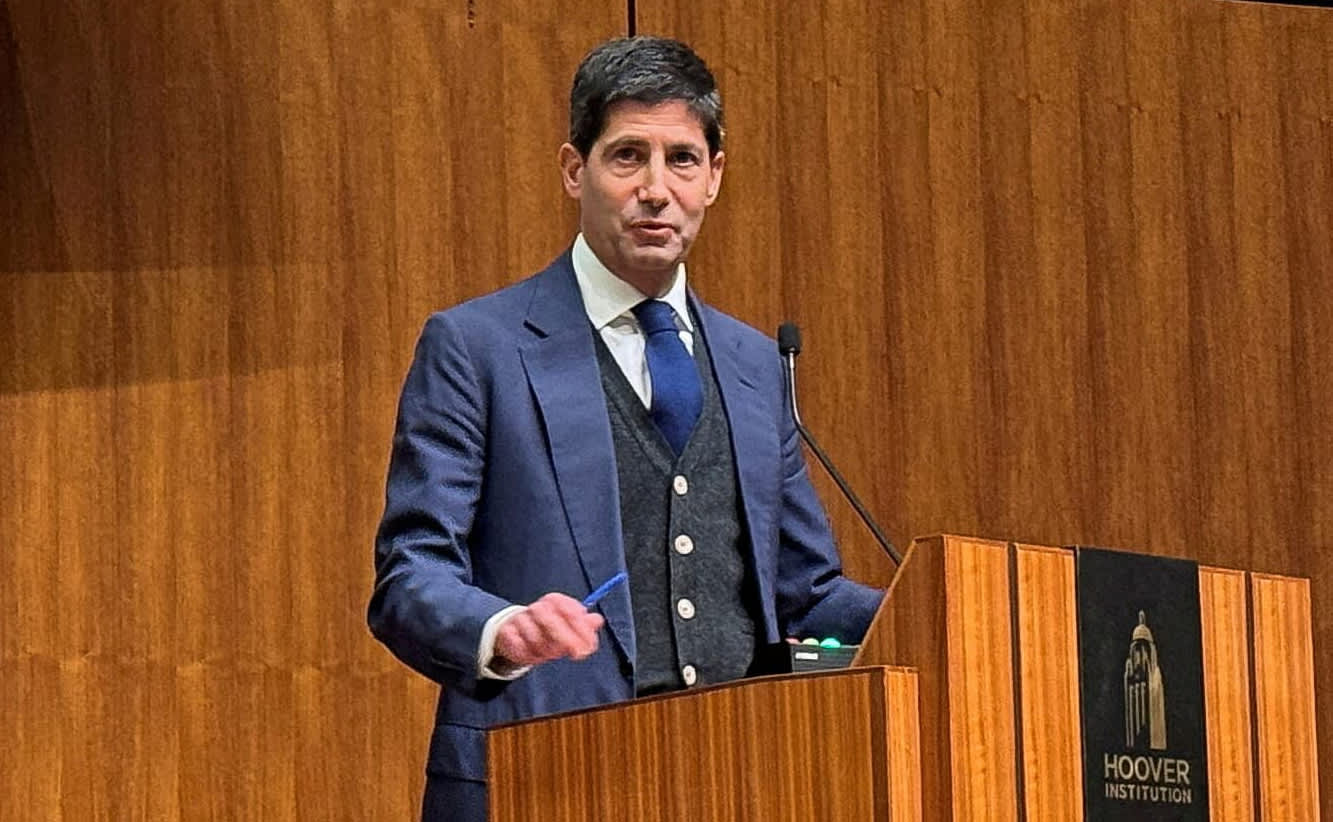
Former U.S. Federal Reserve Governor Kevin Warsh speaks during a monetary policy conference at Stanford University’s Hoover Institution in Palo Alto, California, U.S. May 9, 2025.
Ann Saphir | Reuters
Kevin Warsh, Trump’s pick to be the next chair of the Federal Reserve, will head to Capitol Hill tomorrow for his Senate confirmation hearing, where he will likely face questions about his ties to Silicon Valley.
As CNBC’s Matt Peterson and Steve Liesman report, Warsh’s connections to tech leaders — including Palantir CEO Alex Karp, PayPal co-founder Peter Thiel and venture capitalist Marc Andreessen — would make him the closest person to tech world to lead the central bank. Thanks to his time managing venture-capital investments in the technology sector for investor Stanley Druckenmiller, he’d also be one of the wealthiest Fed chairs ever.
Because of Warsh’s background, a key question this week could be how much access tech moguls would get to the Fed under his leadership. Warsh is known for his free-market and anti-regulatory views, as well as his belief that artificial intelligence could reshape the economy — and, by extension, monetary policy.
3. Looking to merge
A General Motors Co. Chevrolet dealership in Colma, California, US, on Friday, Jan. 23, 2026.
David Paul Morris | Bloomberg | Getty Images
There’s a tale of two fortunes playing out for family-run car dealerships across the U.S. As CNBC’s Michael Wayland writes, more mega-dealerships are springing up while smaller competitors struggle.
Data from a trade publication shows that the top 150 dealers accounted for 27% of all new retail and fleet vehicle sales last year, up from 21.2% about a decade prior. This cohort also collectively owned a quarter of dealerships, up from less thank 20%.
Wall Street has gotten wind of the consolidation trend, too. Dealer stocks Lithia Motors and AutoNation have seen their market caps surpass the $6 billion mark.
4. Code and cash
The Cursor logo arranged on a smartphone in New Hyde Park, New York, Nov. 20, 2025.
Gabby Jones | Bloomberg | Getty Images
Buzzy AI startup Cursor is in discussions for a $2 billion fundraising round, a source familiar with the matter told CNBC yesterday. The company would be valued at more than $50 million, excluding the investment.
Andreessen Horowitz is set to co-lead the round, and Nvidia and Thrive Capital are also expected to participate, according to the source. As CNBC’s Deirdre Bosa and Jonathan Vanian report, such a funding round would symbolize the venture capital industry’s enthusiasm for software startups focused on AI coding agents.
5. The chips are down
Nvidia has left gamers feeling abandoned as it prioritizes AI chips amid global memory shortage and uses AI to change the look of games
Emily Park
While Nvidia has won the hearts of AI fans, it’s losing its luster with another group: gamers.
Gaming was once Nvidia’s bread and butter, but games no longer feel prioritized as Nvidia focuses on its more profitable data center chips rather than its lower-margin gaming products. Its data center business now accounts for more than 90% of Nvidia’s revenue.
“I understand that they’re going to chase that. And that breaks my heart,” Greg Miller, co-founder and host of the Kinda Funny Games Daily video game podcast, told CNBC. “Dance with the one who brought you. Gamers have brought you this far.”
The Daily Dividend
Here’s what we’re monitoring this week:
— CNBC’s Garrett Downs, Spencer Kimball, Azhar Sukri, Terri Cullen, Fred Imbert, Sean Conlon, Matt Peterson, Steve Liesman, Michael Wayland, Deirdre Bosa, Jonathan Vanian and Katie Tarasov contributed to this report.
Davis Giangiulio assisted in the production of this newsletter. Josephine Rozzelle edited this edition.