
Maskot | Maskot | Getty Images
If there is still no clear answer to the question of how artificial intelligence is influencing gains and losses in the job market, there is at least one AI question that job candidates, and current workers hoping to keep their roles, should be prepared to answer clearly in 2026.
“In many roles, the baseline will no longer be ‘Can a person do the job?’ but rather ‘Can they do it in a way that adds unique value beyond what AI can do alone, and what people can do alone?'” said Daniela Rus, director of the MIT Computer Science & Artificial Intelligence Laboratory.
The evolving relationship between AI and human work is a critical issue in the labor market with the technology’s payoff beginning to show up in productivity data, at least anecdotally. Minneapolis Federal Reserve President Neel Kashkari said that artificial intelligence is causing big companies to slow hiring, and that many businesses are seeing “real productivity gains.”
Kashkari told CNBC’s “Squawk Box” that the impact remains mostly at large firms, and overall he expects continued low hiring and low firing in the labor market. But he added, “There are too many anecdotes of businesses using this and actually seeing real productivity gains. Businesses that I talked to that two years ago were skeptical are saying, ‘No, we’re actually using it now.'”
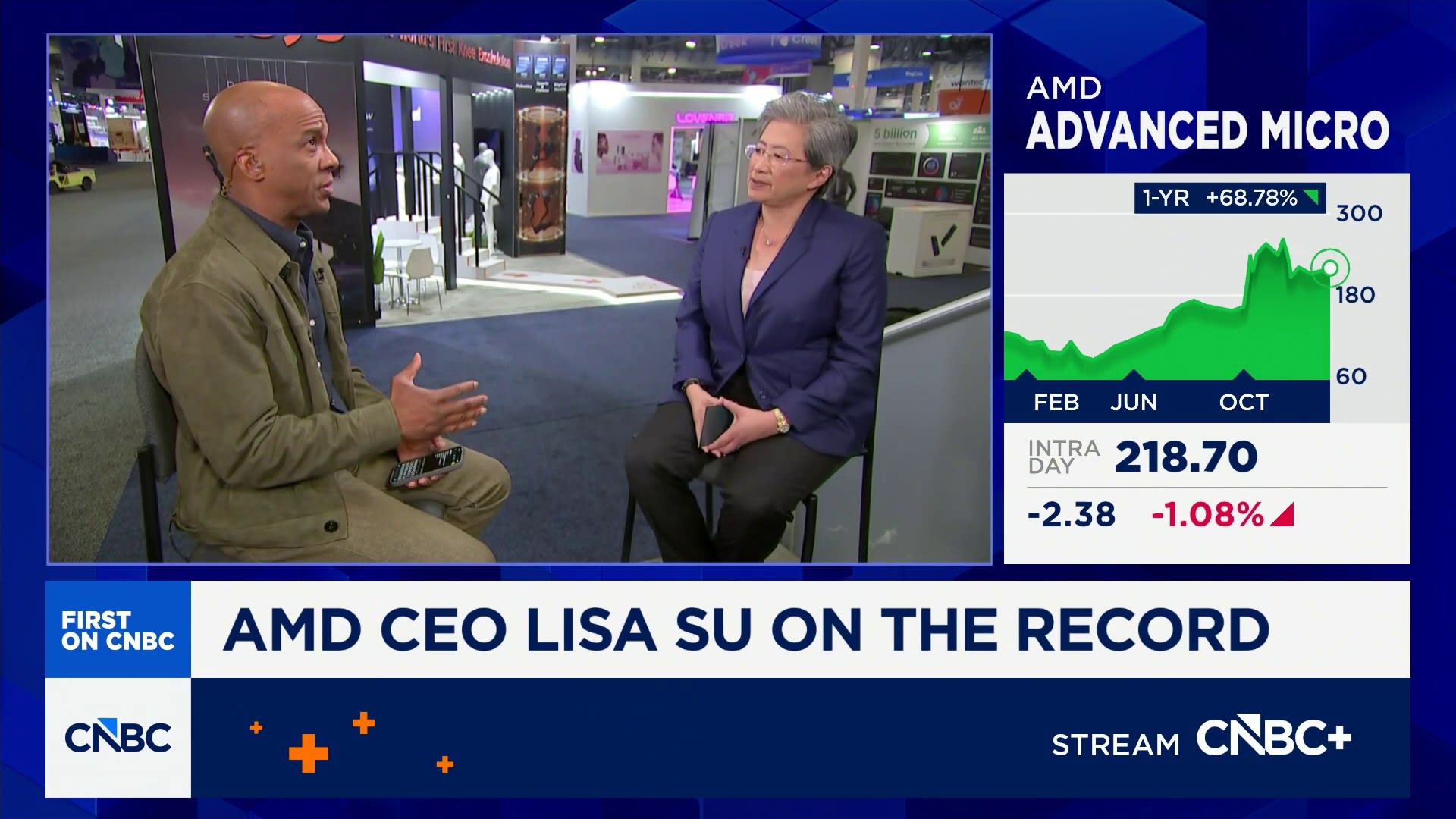
“I would say that we’re actually not hiring fewer people,” AMD CEO Lis Su told CNBC’s Jon Fortt from the CES conference in Las Vegas. “Frankly, we’re growing very significantly as a company, so we actually are hiring lots of people, but we’re hiring different people. We’re hiring people who are AI forward.”
Last year, CEOs at Shopify, Accenture, and Fiverr were among examples of business leaders overseeing layoffs while also urging employees to upskill or face the prospect of finding themselves less relevant in the workforce.
Micha Kaufman, CEO of Fiverr, said when he encouraged teams to “deepen their AI skills, it was not a symbolic gesture. It was a recognition of where the world of work is moving. AI is reshaping every industry, and the most responsible thing any company can do is prepare its people for that change early, transparently, and with purpose.”
Some of the ways that corporations are talking about this shift remain vague, for example, AI handling repetitive or computationally heavy tasks so humans can focus on higher-order tasks involving judgment, empathy, creativity, and context. This vision of human work improved by AI, with the technology in the background, represents “a move from replacement to augmentation,” according to Rus.
But workers would be right to be skeptical.
“These transitions are about efficiency, but also about trust and transparency: workers will need to trust that companies aren’t simply using AI as cover for cost-cutting,” said Rus. She added that there is a risk that rather than amplifying uniquely human skills, the AI transition erodes them.
Kaufman acknowledged transparency from executives can’t eliminate worker anxiety. “By learning to use AI, people might fear they’re training the tools that replace them,” he said. “But I see something very different happening. The individuals who learn to guide AI, to interpret and improve its outputs, are not training their replacements; they are becoming the architects of the next generation of work,” he said.

Fiverr, which offers a platform connecting employers to freelance workers, is on the frontlines of AI adoption since it facilitates work where AI use is rising. According to its 2024 Freelance Economic Impact Report, 40% of freelancers were already using AI tools, usage that Kaufman said was saving on average more than eight hours a week. Its research found that early adopters are delivering better work, and being more highly compensated. “Those who have learned to integrate AI are not being replaced by it; they are thriving because of it,” he said.
A recent study from The Budget Lab at Yale provides some encouragement that the relationship between AI and jobs is so far not all that different from past periods of technological advancement. It concluded that the broader labor market has not been disrupted in the period since ChatGPT’s late 2022 release, and that the available data indicates that AI automation is not eroding the demand for knowledge-based labor across the economy.
The Budget Lab researchers cautioned that no findings can be deemed conclusive in the first few years of a new technology’s deployment, but they pointed to historical precedents, such as the introduction of the computer to offices, that show “widespread technological disruption in workplaces tends to occur over decades, rather than months or years.”
“Even if new AI technologies will go on to impact the labor market as much, or more, dramatically, it is reasonable to expect that widespread effects will take longer to materialize,” the Yale report stated.
A recent McKinsey study forecasted that AI could “theoretically” automate more than half of current U.S. work hours, but added that this view does not necessarily mean job losses. “Some roles will shrink, others grow or shift, while new ones emerge — with work increasingly centered on collaboration between humans and intelligent machines,” its authors wrote.
McKinsey estimates that 70% of desired skills in the job market are applicable to both automatable and non-automatable work. “This overlap means most skills remain relevant, but how and where they are used will evolve,” its researchers wrote.
Companies that heavily lean into AI as a hiring replacement early on may also recalibrate based on experience.
Armando Solar-Lezama, professor of computing at MIT and an associate director at MIT CSAIL, pointed to the example of fintech Klarna, which fired 40% of its workforce in an AI-first policy shift only to have to rehire many workers in customer service after lower-quality performance from the technology. “Some of those efforts are likely to end up backfiring,” Solar-Lezama said. But the individual corporate AI fails should not provide too much comfort to workers across the economy. “Many will succeed and lead to workforce reductions,” he said.
For any workers who currently fear they are being tasked by their employers with training their robot replacements, Solar-Lezama said it is the organizations that may pay the biggest price. Human failure on the job, in fact, remains something of an irreplaceable skill in the workplace itself.
“It is important to note that AI systems do not learn in the same way that people do,” he said. “Existing organizations are set up to deal with the failure modes of humans, so they will fail if you just replace those humans with AI systems. It will take time for companies to figure out,” he added.